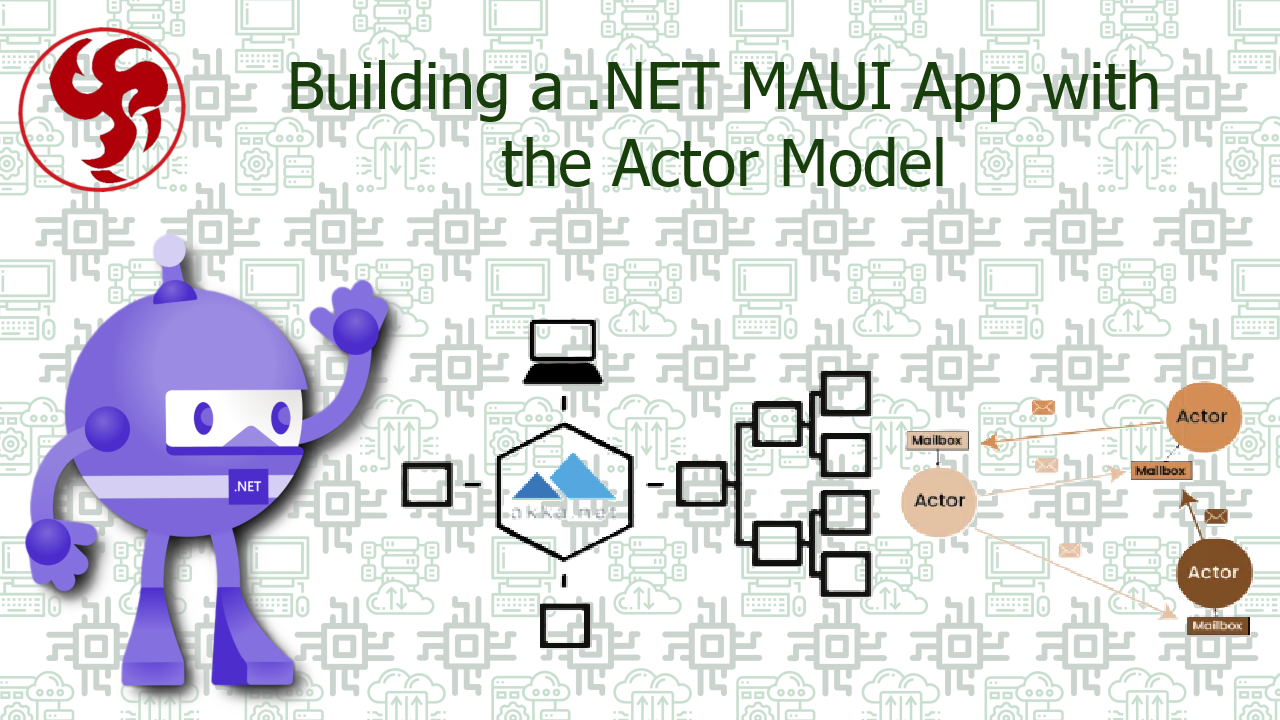
🚀 Building a .NET MAUI App with the Actor Model
🚀 Building a .NET MAUI App with the Actor Model
🧭 Introduction
Modern mobile and desktop applications are expected to be highly responsive, fault-tolerant, and capable of handling concurrent operations such as background synchronization, network requests, user interactions, and real-time updates.
While .NET MAUI provides a powerful cross-platform UI framework for building native applications on Android, iOS, Windows, and macOS, managing concurrency and state safely remains one of the biggest challenges in application architecture. This is where the Actor Model shines ✨. The Actor Model is a concurrency paradigm that treats state and behavior as isolated units (actors) that communicate exclusively through message passing. When combined with .NET MAUI, it enables applications that are:
- More predictable 🧠
- Easier to scale 🔁
- Naturally resilient 💪
In this article, we will explore how and why to build a .NET MAUI app using the Actor Model, its benefits, trade-offs, architectural patterns, and practical use cases.
🎭 What Is the Actor Model?
The Actor Model is a mathematical model of concurrent computation introduced by Carl Hewitt in 1973. It is based on a few simple but powerful principles: Each actor:
- Has its own private state
- Processes one message at a time
- Can:
- Change its internal state
- Send messages to other actors
- Create new actors
⚠️ Actors never share memory directly. This eliminates entire classes of problems such as:
- Race conditions
- Deadlocks
- Complex locking logic
🧱 Core Principles of the Actor Model
| Principle | Description |
|---|---|
| 📦 Encapsulation | State is private to the actor |
| ✉️ Message Passing | Communication happens via messages |
| 🔄 Sequential Processing | One message at a time per actor |
| ♻️ Fault Isolation | Actor failures don’t crash the system |
| 📈 Scalability | Actors scale naturally across threads |
📱 Why Use the Actor Model in a .NET MAUI App?
.NET MAUI apps often deal with:
- UI + background work
- Network calls
- Storage access
- Push notifications
- Real-time updates
Traditional approaches (locks, async state, shared services) can quickly become fragile.
✅ Actor Model Advantages in MAUI
| Benefit | Explanation |
|---|---|
| 🧠 Predictable state | No shared mutable state |
| 🔐 Thread safety | Built-in by design |
| ⚡ Responsiveness | UI thread stays clean |
| 🔁 Easy background processing | Actors run independently |
| 🧩 Modular design | Actors map well to features |
| 🛡️ Fault tolerance | Errors stay contained |
🏗️ Typical Actor-Based MAUI Architecture
A .NET MAUI + Actor Model architecture might look like this:
UI (Views / Pages)
   ↓
ViewModels
   ↓
Actor Gateway / Coordinator
   ↓
Domain Actors
   ├─ NetworkActor
   ├─ StorageActor
   ├─ SyncActor
   ├─ LicenseActor
   └─ NotificationActor
🎯 Each actor focuses on one responsibility.
🧑💻 Example Actor Responsibilities
| Actor | Responsibility |
|---|---|
| 🗄️ StorageActor | Local database access |
| 🌐 NetworkActor | API calls |
| 🔐 AuthActor | Authentication / tokens |
| 🔁 SyncActor | Background synchronization |
| 🪪 LicenseActor | License validation & renewal |
| 📣 NotificationActor | Push & local notifications |
⚙️ Implementing Actors in .NET
You can implement actors in several ways:
1️⃣ Lightweight Custom Actors (Task + Channel)
Using System.Threading.Channels:
public class Actor<TMessage>
{
    private readonly Channel<TMessage> _mailbox =
        Channel.CreateUnbounded<TMessage>();

    public Actor(Func<TMessage, Task> handler)
    {
        _ = Task.Run(async () =>
        {
            await foreach (var msg in _mailbox.Reader.ReadAllAsync())
            {
                await handler(msg);
            }
        });
    }

    public ValueTask SendAsync(TMessage message)
        => _mailbox.Writer.WriteAsync(message);
}
✅ Perfect for MAUI
❌ No supervision or clustering
2️⃣ Using Akka.NET (Full Actor System)
For complex scenarios, Akka.NET provides:
- Supervision
- Routing
- Persistence
- Distributed actors
🔗 https://getakka.net/ ⚠️ Typically used in backend-heavy MAUI apps.
🧪 Actor Model vs Traditional MVVM Services
| Aspect | Traditional MVVM | Actor Model |
|---|---|---|
| State | Shared | Isolated |
| Concurrency | Manual locks | Built-in |
| Error handling | Global try/catch | Actor-level |
| Scalability | Limited | High |
| Complexity | Grows fast | Controlled |
| Debugging | Hard under load | Predictable |
🧠 How Actors Improve UI Stability
In MAUI:
- UI thread must stay responsive
- Background work must not block rendering
Actors naturally enforce this separation:
UI → Message → Actor → Background Work → Result → UI
✔️ No UI freezes
✔️ No cross-thread exceptions
✔️ No accidental shared state
🧯 Fault Tolerance & Supervision
One of the strongest advantages of the Actor Model is failure isolation. If an actor crashes:
- It can be restarted
- Its state can be reset
- Other actors keep running
This is ideal for:
- Network instability 🌐
- Temporary storage failures 💾
- Token expiration 🔑
🚦When NOT to Use the Actor Model
The Actor Model is powerful, but not always necessary. ❌ Overkill for:
- Very small apps
- Pure CRUD apps
- Simple forms without concurrency
⚠️ Adds:
- Architectural overhead
- Message orchestration complexity
🧩 Best Practices for MAUI + Actors
✅ Keep actors small and focused
✅ Avoid UI logic inside actors
✅ Use immutable messages
✅ Centralize actor creation
✅ Log message flows
✅ Combine with MVVM, not replace it
🔗 References & Further Reading
- 🧠 Akka.NET: https://getakka.net/
- 📚 Microsoft: Async & Concurrency https://learn.microsoft.com/dotnet/standard/parallel-programming/
- 📱 .NET MAUI Docs: https://learn.microsoft.com/dotnet/maui/
- 🧵 Channels in .NET: https://learn.microsoft.com/dotnet/core/extensions/channels
🏁 Conclusion
The Actor Model provides a clean, robust, and scalable way to manage concurrency in modern applications. When applied thoughtfully in a .NET MAUI app, it dramatically simplifies state management, improves reliability, and keeps the UI responsive even under heavy workloads. While it may not be necessary for every project, actor-based design becomes invaluable as applications grow in complexity, especially when dealing with background processing, real-time updates, and distributed responsibilities. 🎯 If your MAUI app needs:
- Strong concurrency guarantees
- Fault isolation
- Predictable behavior
👉 The Actor Model is a powerful architectural choice worth adopting.
Was this useful?
Sign in to react. Guest comments are still welcome.
Related Posts

Comments (0)
No approved comments yet.